
In the wake of the financial crisis, few corners of finance were untouched. Roger Johnson, Executive Vice President and Principal of Peachtree Group’s newly formed Equipment Finance division, remembers it vividly.
“I joined Keefe, Bruyette & Woods (KBW), where the focus was on publicly traded banks,” said Johnson. “The platform was bought and sold wholesale loans to help banks balance their portfolios. Then the 2008 financial crisis happened. So, we ended up becoming the ‘garbage truck’ for the FDIC and a number of other clients.”
Over a four-year period, Johnson and his colleagues sold roughly $10.5 billion of problem loans. It was during that time he became acquainted with Greg Friedman and Jatin Desai, who were just launching what would become one of the more dynamic alternative investment platforms in commercial real estate.
Today, Peachtree Group manages approximately $10 billion in assets and has evolved far beyond its hospitality roots. Now, it is placing a strategic bet on equipment finance as the next leg of growth.
From Hospitality Operator to Capital Stack Powerhouse
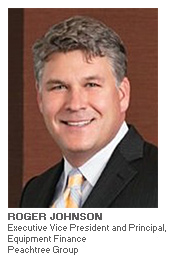
Peachtree began as a hospitality-focused investor and operator. “They were just launching Peachtree as a hospitality enterprise buying and operating hotels primarily,” Johnson recalls.
Fast-forward to 2026, and the firm is a diversified commercial real estate asset manager capable of investing “pretty much anywhere in the capital stack.” Alongside real estate equity and credit, Peachtree has built out CPACE capabilities, is acquiring an SBA 7(a) lender, launching a USDA platform, and now is building an equipment leasing arm.
Greg Friedman, Johnson says, approached him with a vision: “They want to start an equipment leasing platform that can help diversify their customer base, augment what they’re doing in commercial real estate. It’s a real nice bolt-on.”
The strategic logic is straightforward. In a hotel redevelopment, for example, financing needs go far beyond the building envelope. There’s FF&E, HVAC systems, technology infrastructure, essential use, and revenue-generating equipment. By combining CPACE, real estate lending, and equipment finance, Peachtree can address the “complete ecosystem” of a project.
“It’s a very strong ecosystem,” Johnson says. “When we throw a referral over at Peachtree, they jump on it. They’re on a call with the customer typically within 48 hours.”
Hunting for the “Four-Out-of-Five” Borrower
The new equipment finance platform targets transactions between $500,000 and $20 million, with a sweet spot in the $2 million to $5 million range. Products include fair market value leases, capital leases and equipment finance agreements.
But the real differentiator lies in underwriting philosophy.
Johnson reaches for a Winter Olympics analogy to explain…
“I’m a big Winter Olympics fan, and I love the biathlon. In that event, the athletes must hit five targets or they have to skate a lap. If you hit five targets with a bank, you’re probably going to get funded. But if you only hit four, they’re probably going to put your file aside.”
For traditional banks, especially in today’s deposit-constrained environment, borrowers must check every box. Miss one target —sector headwinds, leverage, limited ancillary services, and the deal typically stalls.
“Using the Winter Olympics analogy again, if you hit four out of five, you’re probably not going to get funded at a bank,” Johnson says. “And that’s a prime target for us to evaluate for extending credit.”
The mandate is clear: focus on essential-use and revenue-producing equipment. The platform has already closed approximately 30 transactions in technology, material handling and transportation – including a $5 million loan to a trucking company that “just couldn’t get any more credit from the banks.”
Cannabis is off-limits according to Johnson, but beyond that, the focus is broad, including medical infrastructure and other mission-critical assets. “We’re looking at what runs the hospital,” Johnson notes.
Backed by Strategic Bank Capital
A critical milestone came with the announcement of a $50 million funding facility from Western Alliance Bank, a longstanding strategic partner across Peachtree’s real estate platform.
“Right now, we are a syndication shop and our strategy is to hold and aggregate,” Johnson explains. “If we can get to $100 million on balance sheet, we have a lot of different options.”
Those options include private securitizations to insurance companies or even tapping the public ABS market. For 2026, the goal is approximately $100 million in new origination volume.
“We’ve got a fresh balance sheet in a market that’s highly dislocated,” he says. “That’s a big opportunity for us.”
Dislocation as Opportunity
Johnson’s years covering banks during and after the financial crisis left a lasting impression.
“What I learned at KBW is that deposits really matter today,” he says. Transactional borrowers that do not require ancillary services are finding it harder to secure lines as the value of the relationship is often diminished for the banks. Even strong credits may struggle if they don’t fit neatly within tightened bank parameters.
Meanwhile, some private credit providers that entered aggressively three years ago are feeling the strain.
“We see this dislocation as a big opportunity for us because we can be more creative and flexible,” says Johnson.
Peachtree’s answer is flexibility and creativity, paired with a disciplined credit culture. For now, Johnson and a lean team handle the bulk of underwriting, but hiring across credit, operations, and origination is planned throughout 2026.
“We kind of joked that we’re building the plane as we fly it,” he says. “But credit culture is incredibly important to us.”
Building the Tech Stack from Scratch
Unlike legacy players burdened by aging systems, Peachtree’s equipment platform is starting with a clean slate.
“One of the benefits of starting from scratch is that we get to build the tech stack from the ground up,” Johnson says. “We’re in that unique position where we don’t have to deal with any of the legacy issues.”
The firm is evaluating portfolio management and origination systems that can support a seamless path “from idea to concept to funding.” AI and workflow automation are expected to play a central role in driving efficiency and scalability.
In a competitive market, speed and certainty of execution may matter more than lowest cost of capital.
“If I’m that CFO,” Johnson says, “the lowest possible cost of capital may not be the best solution.”
A Billion-Dollar Ambition
Despite the incremental buildout of the division, the long-term target is anything but modest.
“Our goal is to get to a billion dollars of AUM,” Johnson says. “Whether that’s assets under management through securitization, or whether it’s balance sheet, our goal is to get to a billion dollars.”
That ambition is supported by Peachtree’s origination network, which Johnson describes as “very impressive.” In the first 90 days alone, the equipment team fielded 25 to 30 calls from developers and operators across the commercial real estate ecosystem with equipment needs that extended beyond core real estate.
For Johnson, who has integrated into multiple firms over the course of his career, the cultural fit has been notable.
“The integration of what we’re bringing into Peachtree’s daily model has been absolutely outstanding,” he says. “They’re welcoming. They’re team-focused and everyone is focusing on building the platform.”
In a year marked by pent-up CapEx demand and ongoing market dislocation, Peachtree is betting that fresh capital, disciplined underwriting, and an integrated platform can convert four-out-of-five borrowers into long-term portfolio assets.
If Johnson’s biathlon analogy holds, missing a target at a bank may simply mean finding a different finish line.