
For much of the past decade, the equipment rental industry benefited from sustained demand, favorable capital conditions and rapid expansion. Many rental businesses grew quickly, adding fleet, locations and systems to keep pace with customer needs in a supply-constrained environment.
That environment is changing.
The 2026 State of Rental Report, drawing on more than 50 Rental Roundtable podcast interviews, a survey of over 35 independent rental operators, and anonymized platform data from Quipli customers, examines how rental leaders are responding to the shift from growth-driven expansion to execution-driven operations. The findings point to a clear theme: performance gaps across rental businesses are widening, not because demand has disappeared, but because day-to-day operations have become harder to manage.
A Slower, More Selective Growth Cycle
Industry-wide forecasts reinforce that the equipment rental sector is entering a more disciplined phase. The American Rental Associationprojected U.S. construction and general tool rental revenue growth slowing to 3.3 percent in 2025, totaling $80.5 billion, followed by further deceleration to 2.3 percent growth in 2026. In Canada, the slowdown appears even more pronounced, with growth expected to drop to just 0.6 percent in 2026.
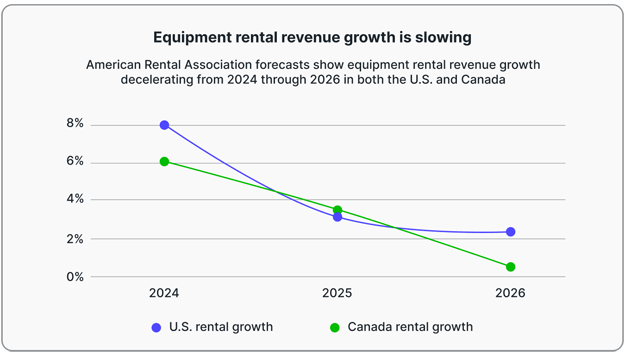
Importantly, this outlook reflects uncertainty rather than contraction. Scott Hazelton, consulting director at S&P Global, emphasized that the defining challenge is not a sudden loss of demand, but the prolonged duration of policy uncertainty. Tariff negotiations, shifting trade assumptions, and limited availability of new construction data complicated forecasting and weighed on business confidence throughout late 2025.
On the supply side, visible signs of normalization are appearing. Clement Cazalot, co-founder and CEO of Machinery Partner, described record-breaking volumes of equipment at recent auctions, including entire rows of brand-new mini-excavators and attachments — a signal of a market carrying more inventory than it can immediately absorb.
The conclusion across multiple perspectives is consistent: the rental industry remains fundamentally healthy, but the margin for inefficiency is narrowing. Growth is no longer sufficient to mask operational weaknesses.
Customer Intelligence Becomes a Competitive Requirement
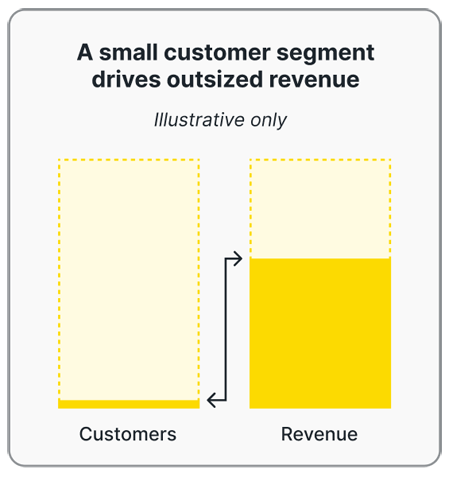
As growth moderates, advantage is shifting from broad customer coverage to a deeper understanding of the customers that matter most. Operators consistently described a move away from treating all customers equally and towards intentionally prioritizing a smaller set of high-impact relationships.
Survey data reinforces the gap between awareness and execution. When asked whether they actively analyze which customers drive most of their revenue, 45.9 percent of respondents said they do so regularly, while 48.6 percent said they do so only occasionally. Nearly all operators recognize that customer value is uneven, but fewer than half have made it a consistent operating discipline.
The concentration is striking. Nick Mavrick, CEO and founder of BiltData.ai and a former executive at NationsRent and Volvo Rents, noted that approximately 3 percent of customers drove more than 60 percent of total revenue at NationsRent, with the top 11 percent accounting for more than 80 percent. His advice: identify 15 to 30 priority customers per location and align capital, service levels and sales effort around serving those accounts exceptionally well.
From the customer side, expectations are rising too. Rental customers increasingly prefer working with fewer partners who understand their operations and can reliably support multiple needs. The relationship is shifting from transactional fulfillment to application-specific support.
Specialization Rewrites the Competitive Map
General rental alone is increasingly difficult to defend. Joe Kondrup, a co-founder of United Rentals, and Josh Mosko of Catalyst Strategic Advisors noted that metropolitan areas can absorb only so much undifferentiated fleet before additional equipment begins to dilute rates rather than generate incremental profit.
The structural response is specialization. Mosko noted that approximately 40 percent of United Rentals' business is now driven by specialty equipment—a deliberate shift away from commodity rentals. Large infrastructure, data center, and industrial projects increasingly require engineered solutions that combine equipment, accessories, and technical support into complete systems.
For independent rental companies, the opportunity is significant. National operators often struggle with the localized complexity of specialty equipment, creating opportunities for regional companies with deep market knowledge. Equipment requirements vary significantly by geography, geology, climate and industry, which limits the advantages of national scale and rewards operators who can tailor their fleets and services to local demand.
Culture as an Operating Advantage
As rental companies grow more complex, culture has shifted from a soft concept to a structural one. Leaders described culture not as a set of values, but as the system that determines how decisions are made, how quickly problems are resolved, and how consistently customers are served.
At City Rentals, decision-making authority goes to the front lines. Counter staff are empowered to refuse rentals, yard teams flag suspicious behavior, and delivery drivers assess job sites independently. Employees are never penalized for protecting the business. At Premier Truck Rental, integrated teams of territory managers, inside sales representatives, and rental coordinators own their customer relationships with minimal micromanagement.
Unlike fleet or facilities, culture compounds. Strong cultures improve execution, reduce turnover, and create consistency across locations. Weak cultures amplify complexity and slow decision-making as organizations grow.
From Hustle to Data-Informed Operations
For many independent rental companies, early success is built on hustle. But a consistent pattern emerged across interviews: what drives early growth eventually becomes the constraint on it.
Quipli platform data illustrates this tension. Overall, on-rent utilizationimproved modestly from 2024 to 2025, but performance dispersion widened, with the interquartile range expanding from 7.6 to 10.6 percentage points. The gap between top-performing and struggling operators is growing.
As complexity increases and experienced workers leave the industry faster than new entrants arrive, reliance on individual memory and ad hoc coordination becomes riskier. Sustained growth requires moving operational knowledge out of individuals and into shared processes to improve visibility and consistency.
AI as a Discipline Multiplier
AI is no longer a future concept in rental — it emerged as a practical response to the growing gap between operational complexity and human capacity. Importantly, operators and technologists framed AI not as a replacement for people, but as a way to reinforce discipline and speed in parts of the business where manual execution breaks down under volume.
The clearest use cases concentrate on high-volume, time-sensitive workflows: customer response, pricing and availability decisions, invoicing, and follow-up prioritization. AI delivers value where work is repetitive, rules-based, and requires fast response—precisely the areas where human execution tends to degrade as volume increases.
A consistent caution accompanied every AI discussion: AI amplifies whatever operating discipline already exists. Without clear workflows, reliable data, and defined ownership, automation accelerates confusion rather than reducing it.
What This Means for Rental Leaders in 2026
The defining challenge for rental leaders in 2026 is not a lack of opportunity, but a narrowing margin for error. The companies that emerge strongest from this phase will not be those that moved fastest, but those that built with intention.
Discipline is no longer something to layer in later. It is now a prerequisite for sustainable performance. In a market where execution matters more than growth, clarity becomes the most durable advantage.
The full 2026 State of Rental Report is available from Quipli, with detailed data, expert interviews, and operational insights across customer intelligence, specialization, culture, data discipline, and AI adoption in the rental industry.