
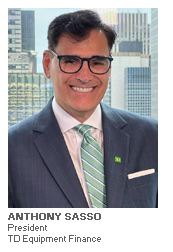
Anthony Sasso, President of TD Equipment Finance joins Michael Toglia, Publisher of Equipment Finance Advisor, to discuss the critical role bank-owned leasing companies play in the equipment finance industry and the advantages they offer amid growing competition from independent and private credit providers.
Michael Toglia: Thank you for joining me, Anthony. As lessees increasingly evaluate alternative structures for equipment investments, in what situations can a structured lease offer greater tax efficiency than traditional debt financing, and how do you guide clients in assessing those trade-offs?
Anthony Sasso:At TD Bank, we try to take a consultive approach with all of our clients. It's not about products. We don't have incentive plans that promote one product versus another. We focus on what is in the best interest of the client. The starting point is usually conducting a lease versus buy analysis and a review of any considerations related to the preservation of liquidity. We often lean less towards the loan, which many times have an 80% LTV in the commercial banking world, versus 100% financing on leases.
There are other structures we provide that maximize tax benefits – in other words, tax leases. We find that clients that are desirous of tax products want the lowest cost component possible and lowest monthly payment – in those cases we are taking depreciation benefits and residuals in the form of a balloon or TRAC lease to provide a lower monthly payment as your readers know.
There are other structures that we have beyond tax structures. We offer synthetic leases that allow clients to take that depreciation, and we can still offer some vestige of off-balance sheet treatment for them. Fair market value leases also are part of our product suite. We try to just drive to what is the most optimal financing structure for the client. So, whether we provide a loan or a lease, we always try to provide what is most favorable for the client. With the passage of the One Big Beautiful Bill, we now have 100% bonus depreciation which actually effectuates the best trade for those benefits when we monetize those benefits. With that said, we can deliver a very low-cost component.
It’s interesting to note that prior to the recent geopolitical events, interest rates were starting to come down, but the key question remains whether they are low enough to meaningfully accelerate capital investment. Last year we saw many clients on the sidelines for equipment purchases – including clients that traditionally have very large capital expenditure budgets. There was still a CapEx need, but it was not as robust due to interest rates remaining elevated.
Overall, we look at all these variables.
Toglia: How do bank-affiliated leasing companies differentiate themselves from independent lessors in delivering tax-efficient financing solutions and what advantages do bank leasing platforms offer in terms of balance sheet strength, syndication capabilities, or cross-selling treasury and credit services?
Sasso: I think it is probably one of the strongest considerations for a client. According to the ELFA, in 2024, banks owned 55% of the equipment finance market. I think when I joined the bank in 1986, that statistic was probably in the 30% range. Independents were capturing a lot of the market, but we have seen a natural gravitation towards the bank-owned leasing sector because of that flexibility.
As a bank, we have the ability to cross-sell a full product suite to a prospect. When we entered the large corporate space years ago, we dealt with a lot of bank clients because we were in their bank group, but when we met with prospects, many of them would say, "Talk to me about your large corporate lending component. Talk to us about treasury management." They wanted to know if they would be working with a bank-owned leasing company that also had the flexibility to bring in other partners if they needed it. Many larger companies look for that share of wallet in terms of products and services in case they need it, versus working with, say, an independent which cannot provide these other products and services. I believe this trend will continue. And of course, a bank’s cost of funds is certainly advantageous, so I envision continual market share growth for bank-owned leasing companies.
Toglia: How does the bank approach residual risk management, particularly in sectors like transportation or specialized manufacturing equipment?
Sasso: We've been very realistic in terms of understanding the secondary market. We have a highly experienced team of asset managers, many of whom are certified equipment appraisers. We really understand that secondary market and what we deliver is realistic residual positions.
Toglia: Is that harder to do this because of all the variables in the marketplace including tariffs and some supply chain issues?
Sasso: No doubt. In fact, that complicates matters because you're looking at inflated costs.
Most of the players in the residual space tend to look at residuals in a normalized environment. We try to distill down any anomalies that may be more current state. I would say that if I think about the last 10 years, the demand for the fair market value product has been far less than I've seen in years prior to that period. I think that some of that may be born from bad experiences. If we lose a fair market value deal, it's certainly not on spread and cost of funds. It's going to be on the residual. And we try to advise our clients to be very careful about residual positions.
There's another dynamic that one operates under in the bank-owned leasing company space, particularly when you're working with some of your larger clients in the large corporate space. We always try to be realistic, and we explain that there's a relationship play here. We don't want to disturb a bank relationship because we took a very aggressive residual position, and now we're pulling all the strings out to try to get it. We're going to be very realistic as we want to show value and preserve a long-term relationship.
Toglia: Which sectors are currently showing the strongest growth in equipment leasing demand, and what’s driving that momentum?
Sasso: We have seen many opportunities in the tax-exempt municipal space both in our footprint and nationally. We're seeing a lot of long-term energy deals, 15- and 20-year terms on energy savings equipment, as well as everything underneath the surface. That's been a pretty good growth area for us.
On the commercial side, the middle market has also been a key growth driver for us, supported by strong alignment with our broader banking teams. It's been a good growth factor for us over the last 24 months.
The large corporate sector is still seeing very good activity, even though CapEx spending has been cut back for some large companies.
I'd say another segment would be healthcare. We've had a healthcare vertical going back to 2004, and that's been very good for us. In the past, we saw more bond financing in this sector, even for equipment financing. Today we are seeing a change in that activity. We're also seeing some sale lease-back opportunities in healthcare including in hospitals and large systems, which are struggling with either rising nursing costs or other cuts like proposed Medicaid cuts the administration's putting through. They are looking at ways of raising capital, and many hospitals have purchased equipment over the years, which allows us to do a sale leaseback. That product has gained some momentum over the last 18 months for us.
We've seen sluggishness certainly in the transportation logistics vertical. In that sector, we've seen a lot of cutbacks in terms of asset purchases. It's been extraordinarily competitive as there's probably more of a flight to quality, but we’ve all seen the statistics in that sector and the cutbacks in class A trucks.
I'm an optimist by nature. I would say that I feel that in 2026, we probably will hit a trough where we may see that industry coming back. It's been a survival of the fittest situation. But some companies have picked up good market share over the years, and we're starting to see more of a rebound in the transportation sector.
Toglia: Looking ahead 3 to 5 years, where do you see the most innovation or growth in equipment leasing structures – whether in transportation, construction, energy, healthcare or technology assets?
Sasso: I see growth mostly under traditional structures as we are in a mature industry, with one caveat; we have seen an evolution in leasing-as-a-service. We have many data centers being built and energy is needed to service those centers. We see more opportunities for utility companies that are expanding and this will also drive investment. Hopefully, if the administration is correct, we will see more onshoring of manufacturing, and that should create additional opportunities. We're not seeing that yet today, but even with that said, over the next couple of years, I think you're going to see more opportunities in the manufacturing sector.
Healthcare, as I mentioned, is strong and we have an aging population. I think we are going to see more opportunities in the healthcare space. In that space, there are some other structures that could be beneficial such as leasing-as-a-service.
Defense spending is going to be an area where you're going to see more activity, and with that comes with the need for more machine tools.
Toglia: Is there anything I left out that you'd like to wrap up with Anthony?
Sasso: I feel good about the fact that we can support TD customers across a wide range of needs. We try to stay abreast of what's going on in all our markets and certainly in the economy. Last year, there was a ton of uncertainty as we started seeing the tariffs unfold. A lot of our clients were asking us, "Is there a better structure? Is there something we can do to hedge interest rates going forward?”
From our perspective, we want to work with our clients, give them flexibility, and bring domain expertise in multiple verticals. I am remaining optimistic that in 2026 we'll see more of an uptick in overall leasing volume. We're excited to be part of that equation with our clients.