
Dan Corazzi, Chief Executive Officer of Solifi meets with Michael Toglia, Publisher of Equipment Finance Advisor, to discuss insights from the Solifi 2026 Global Leasing Report, produced in partnership with the World Leasing Yearbook. In this interview, Corazzi explores the key drivers behind the global leasing market’s growth to $1.54 trillion in new business volume, emphasizing the role of flexibility, resilience, and evolving risk management practices. The conversation also examines how economic volatility has reinforced leasing’s advantages, the growing importance of predictive analytics and AI, and why a shift toward platform-based, lifecycle-focused strategies is critical for lenders aiming to remain competitive in an increasingly digital and data-driven equipment finance landscape.
Michael Toglia: The Solifi 2026 Global Leasing Report produced in partnership with the World Leasing Yearbook, shows global leasing reached $1.54 trillion in new business volume in 2024. What do you see as the most important drivers behind that 63% growth over the past decade, and are those drivers sustainable?
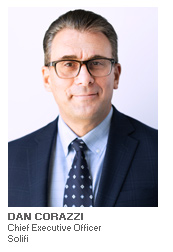
Dan Corazzi: First, it's a large number, $1.54 trillion, and it's certainly grown over the last decade. Solifi is always excited to be part of this because it's our core business. I’d probably tie the decade’s worth of growth to a few factors. First, over the last 10 years the asset economy has been growing and expanding as a whole in many diversified areas. Secondly, if I put my software hat on for a moment, it’s clear that finance models are becoming more flexible, and we see that for the leasing industry, our software needs to be more flexible to meet the needs of customers. Third, I think in almost every business today, risk management is critical. Not only do you need speed to win, but you also need structure and controls – in essence, you really need all those things.
As to whether it's sustainable or not, I think it is sustainable. I believe as long as we, Solifi, help customers with what I'll define as predictability, visibility and compliance, we can help them grow in the next decade.
Toglia: This growth occurred despite persistent inflation, supply chain disruptions, and monetary tightening. From your perspective, what does this say about the resilience of the leasing model compared to other forms of financing?
Corazzi: Stepping back a moment, I think about leasing as a consumer going back to, for me personally, almost 15 years leasing vehicles and different things versus other mechanisms. I've seen its resiliency for many years as a consumer. Leasing is secure and structured. And again, I'm going to put my software hat on for a second and say it's adjustable and flexible depending on what you want to do inside the process. I think inside the context of your question of when volatility arises – and we're in a world now where there's tremendous volatility – both lenders and borrowers need to know the value of an asset and require flexible financing terms. From my personal point of view, I think leasing provides all this. I believe the resiliency will continue for the next decade to come.
Toglia: Do you think that there's pent-up demand in the market?
Corazzi: When I look at our customers and prospect base, I think there's pen-up demand in certain areas; not in all areas. Some of that gets defined by geography and vertical. So, I'd say yes, but not in all cases.
Toglia: The report highlights that North America, Europe and Asia account for 96% of global leasing volume. Do you expect this concentration to persist, and are emerging markets poised to take share? Where do you see the next wave of growth coming from—deeper penetration or geographic expansion?
Corazzi: What's really interesting to me about that question is the makeup of that percentage. The reason I say that is, and I always try to put things in Solifi terms, 95% (not 96%), but 95% of our business comes from North America, Europe and Asia. So, we align almost to the penny, with what you just stated. About 50% of that is North America for us. The next greatest percentage is EMEA, and then probably 10 to 12% is Asia-Pacific-Japan (APJ). As to concentration, I think it will persist most likely because of three things I watch daily including: capital pools and how large the capital pools are; strong vendor ecosystems, and where those stronger ecosystems are sitting today; and lastly, mature asset distribution.
When I start to think about growing in different areas and emerging markets, I'm going to again put on my Solifi hat. We’re looking at a few countries in Europe that we didn't look at in the past. There are certain APJ regions with evidence of growth. I would also say certain areas in South America may have some growth potential for us. I think things leapfrog from a modernization perspective when those digital operating models are attracting different funding, and there's a cross section from the deeply penetrated to where modernization is. Last thing I would say is, again, when I look at the bulk of our revenue, I think there'll be more on the go deeper side than there will be on modernization, but we will do some of that as part of it.
Toglia: Secured finance is a connected ecosystem, where stress in one segment spreads across portfolios. How should lenders rethink risk management in this more volatile environment? What practical steps should firms take to break down siloed risk management?
Corazzi: Every customer that we speak with today wants to have a risk management discussion. It's become very interesting and that's changed a lot in the last 18 months. So, I'll start there. I think they need to treat risk management as, in my terms, like a lifecycle system. Because when you look at risk management, it's spread across multiple areas including funding, collateral values, operations, and compliance. It's not just determining if credit is available. I think risk management as a whole has a very large purview of a number of important people inside organizations. The last thing I would add is that I feel there is a shift from reporting the news, to having, from a risk perspective, continuous visibility, predictability, and the ability to see the future inside of that risk profile. I think that's potentially the biggest shift – static data versus very active and dynamic data.
Toglia: Are people looking for predictive analytics at this point?
Corazzi: Yes, absolutely. We're building and moving totally towards predictive data for the customer to help them make decisions and not just analyze static data. That's not a 2026 trend, rather I think that trend has been around since 2024, but it's becoming more apparent now in 2026.
Toglia: It seems like the risk managers used to express a degree of reluctance to rely on technology at the level that they're relying on it today. Do you think there's still some of that out there?
Corazzi: I think there's always a bit of reluctance when it comes to technology. I don't believe that ever goes away, but I believe there are a couple driving factors behind that. I think people are now on a daily basis seeing what they can get with that technology – what automation and efficiency brings. I've sat at a number of conferences this year, and in this particular vertical, we've watched the changing of the workforce. There are people who are aging out, so the group that's coming in uses technology with their eyes closed – which I believe reduces the amount of reluctance as well.
Toglia: The broader report includes analysis of AI and digitalization in leasing operations. How quickly do you expect these technologies to shift competitive advantages among lenders?
Corazzi: Before I answer that question, let me just tell you in a minute or so what has dynamically changed for Solifi. It's amazing in the last nine months how much time we have spent on AI. I just delivered our strategic AI roadmap to the board. It was a one-year roadmap, and also a three and a five-year roadmap. Internally, we're using Copilot cross-functionally – finance, marketing, sales, you name it. When you look at the software and the customers from a coding perspective, we've adopted Anthropic and Claude. It is moving so fast and I can give you an example. A bug that might have had 2,000 man-hours associated with it was put into Claude which consumed it, and delivered it, and fixed it to 100% accuracy in 30 minutes. So back to your question of how fast is this moving? I think from an operational perspective, it's moving at hyper speed. Now, I think when you get into core credit judgment and the basics, it's not going to move quite as fast. But let me tell you, cycle times are moving incredibly fast, exception processes are moving fast. Audibility can also get better because of this. As long as the lenders can trust the data and trust what's being done, it's going to move faster and faster. Internally within Solifi, I can't explain to you how fast it's moving right now.
So, we’re talking about a resource who might've been on a project for 9 to 12 months, seeing it solved with computing in 30 minutes. It's mind-boggling. If you put all that data in the right repository, when you go to work on the next feature or the next bug, it learns and gets smarter and it can fix the next thing even faster. I think it's going to transcend the industry. For the lenders, I think it's going to impact the way they conduct business.
They're going to want to use AI in their own formats because quite honestly, it's just going to make them much more productive, and it's going to make them more efficient.
Toglia: Is the embrace versus resist conversation still prevalent from your perspective?
Corazzi: I think five years ago, there was so much of the resist, but in 2026, almost everybody embraces it. The only caveat, and I look at in the equipment finance space, are the customers who have been sitting on legacy technology for 25, 30 years. They want to embrace it, but the questions then become, from an assessment perspective, "Do I have the technology stack? Do I have the people to support it? Do I have the monetary means to make that conversion?" I think it's absolutely embraced.
Toglia: If you had to distill the report into one message for finance industry leaders, what is the single biggest strategic shift they need to make right now to stay ahead?
Corazzi: There's a lot in that one. I'd probably say stop some of the things that you've done in the past and stop optimizing current processes and try to look at things in a different lens. And I would say, start optimizing for predictive analysis and predictability, optimize for visibility and intelligence, and look across your entire life cycle of what you do; don't look at things in silos. I would also not look at individual systems. That comment is a bit self-serving because at Solifi, we view ourselves as a platform, and when you have a platform view, you can move data back and forth, you can get information, you can make decisions. Don’t stay with individual systems because they can keep you stuck in the past. I think you have to have more of a platform view.
And lastly, lean into the risk discussion. Lean into your question about, "Do I have trepidation about doing things?" Because if you don't do that, much like us as a software company, if we don't lean into AI, we're going to be left behind and not be accepted.
Toglia: Dan, is there anything I didn't ask today that you want to discuss?
Corazzi: No, I think you hit the higher topics. I think right now the hottest thing out there is AI. I believe it's really about how we can get with these customers and help advance them forward. We need them to explain to us what their use cases are as we cannot make decisions in a bubble. They need to tell us, "We're working on originations with AI, we're working on credit analysis with AI, we're working with payables on AI." We need them to put their use cases on the table in order to create efficiency and drive the future of the equipment finance industry.