The Issue
CFOs are often faced with the task of comparing loans and leases when financing new asset acquisitions. The product options have different asset and cost patterns and amounts. The issue is to put the financial reporting results of different financing options on a level playing field for comparative analysis and decision-making. As an example, an operating lease has level costs, while a borrowing to buy has front-loaded costs. Finance leases also have different financial reporting attributes than operating leases and loans. Leases are capitalized at less than the asset cost when borrowing to buy.
Asset finance salespeople also need to show their customers the benefits of their product offering compared to competing loans and leases, all of which typically have different asset and cost profiles. They need to put their offer on a par with other options for comparison and demonstrate its benefits logically, clearly, concisely, and in a hard-hitting way.
Lessors face the same problem when considering buying residual value insurance (RVI) to change the classification of an operating lease to a direct finance lease. Do the different financial reporting benefits justify the cost of the RVI premium?
The Answer
The answer is:
- To use a present value weighted average return on assets (PVROA) financial statement presentation for the options being evaluated,
- To compare the capital used and the resulting cost of capital
- To also consider the cumulative balance sheet and earnings implications/benefits of repeating the same transaction year after year.
How it’s Done
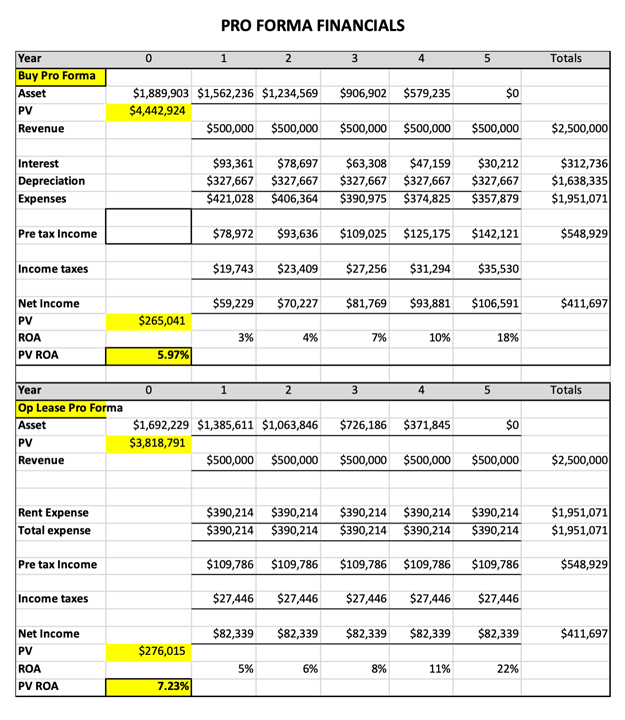
Annual asset balances and net revenue amounts are run out in proforma financial statements for the transaction's life for each product option. Annual return on assets (ROA) is calculated by dividing the asset balance by net revenue for each year. The annual amounts will vary. The final step is to present value (PV) the asset balance and net revenue amounts and divide the PV of the net revenue by the PV of the asset to arrive at the PVROA for the financing options. The result allows an “apples to apples” comparison. The result weights the amounts and applies a time value to them.
The cost of capital, based on the pro forma financial runouts of the financing options under study, is compared. The option with the lowest capital need (the lowest asset amount) is usually the best. If the customer has a high ROE and a low leverage ratio, the cost of capital differences will be larger, meaning leasing vs borrowing to buy shows better results.
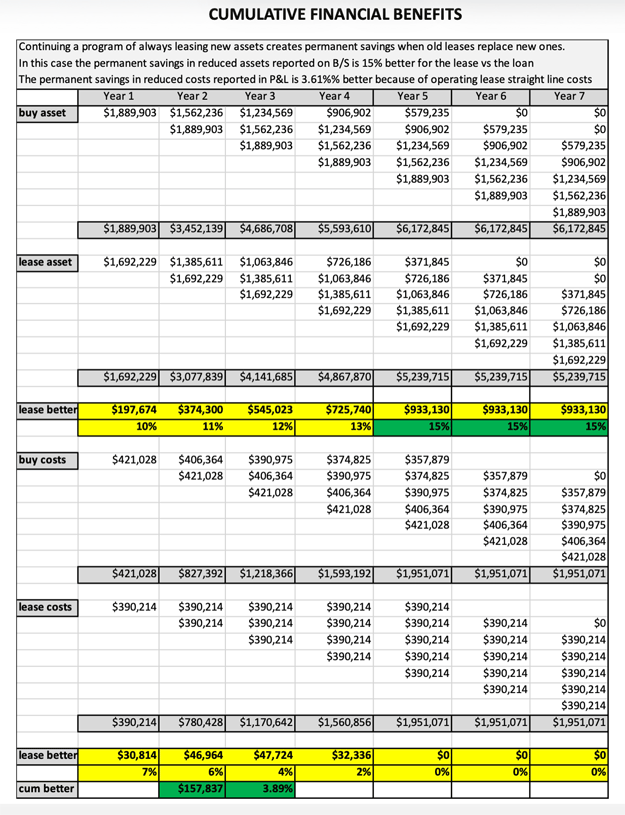
Another consideration is how the transactions compare if a new transaction of the same amount is added every year (say, a customer leases or buys new company cars each year)—a cumulative benefits analysis shows the portfolio benefits. Positive timing differences in earnings/capital and asset balance differences can be permanent if companies continue to lease the same amount of assets, or more, annually.
Considerations
- You are how you are perceived: Investors and lenders use financial ratios and measures to analyze target companies. How a company’s performance “looks” is a very important factor in determining its market share price.
- Shareholders have a time value preference to earnings: A dollar in earnings and capital today is better than a dollar in the future. Shareholders buy and sell investments and want current, not future, performance. Their rate-of-return expectation is a company’s return on equity (ROE), which is one of the key measures that determine share price. When comparing financial alternatives with differing GAAP-reported results, the best discount rate to use to put them on a common basis is the company’s ROE.
- Economic yield may not be the same as GAAP returns: Companies are measured by reviewing financial statements. Generally Accepted Accounting Principles (GAAP) are rules that are not necessarily based on pure mathematical financial calculations, such as after-tax yield on investment or internal rate of return on cash flows. Investments or transactions should be measured at the amount reported to the investing public. Remember, you are how you are perceived. Do not ignore the after-tax investment yield, as it must be positive, but the GAAP return on assets is how you are measured. Individuals look at after-tax returns on cash invested, while public companies look at GAAP returns on assets and equity.
- Capital is expensive: Different financing products produce different reported asset amounts (leases often capitalize at amounts lower than the cost of an asset when borrowing to buy). Investors expect a company to have an asset-to-equity ratio appropriate for its business model/industry/ risk profile – the riskier the business, the less leverage is acceptable. As a result, different product options can reduce capital needs and positively impact the cost of capital.
Case Study
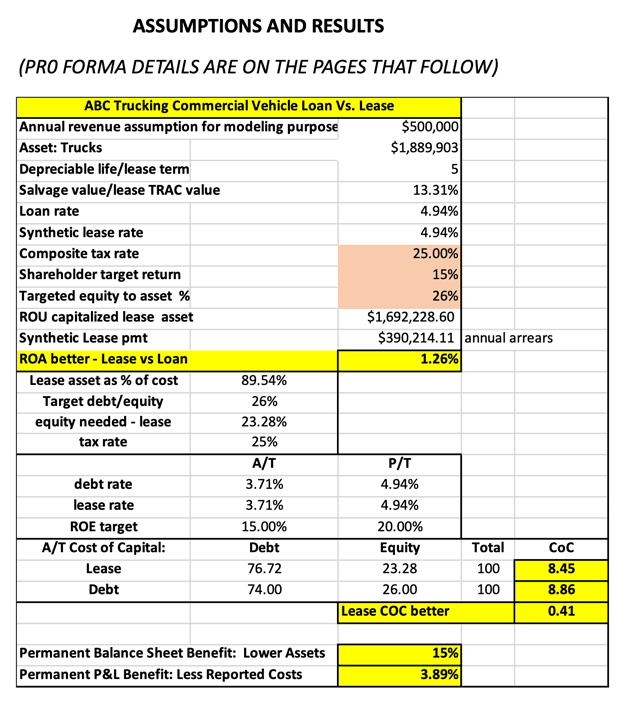
Summary of benefits of a truck financing – 5-year loan versus operating lease:
See the tables below for details.