
For years, underwriting technology has been designed around a simple operational model, i.e. information moves through a defined sequence of steps until it reaches a decision.
First, the data is collected and enriched with third-party sources & then evaluated against policy. Finally, it reaches the approved or declined stage.
When inputs are clean and aligned, this structure delivers efficiency and consistency.
The difficulty is that real underwriting rarely behaves this way.
Credit evaluation does not come in a fixed order. It adapts as new signals emerge. A discrepancy may trigger additional verification & whole workflow.
A cash flow pattern may require contextual review before policy thresholds can be applied. A strong operating profile may mitigate a historical weakness, changing the direction of the assessment midstream. The path of the deal evolves as understanding deepens.
When underwriting is forced into a linear architecture, this adaptive reality creates friction. Work then gets paused, branches manually, and re-enters the workflow through informal channels.
And judgment becomes fragmented across tools. Context does not travel cleanly between tasks. Over time, scale is constrained not by effort, but by structure.
If underwriting is inherently non-linear, then scalable underwriting must be built on a different foundation. The question will not be to accelerate the pipeline, but how to design systems that reflect how credit decisions are actually formed.
Real Underwriting Is Adaptive, Not Sequential
In practice, underwriting does not progress as a predetermined checklist moving from one stage to the next. It develops in response to what emerges during analysis. The order of evaluation is often dictated not by workflow design, but by the signals contained within the deal itself.
An application may initially appear straightforward until a discrepancy surfaces in business verification, prompting further identity checks before financial assessment can proceed.
A cash flow review may begin as a standard revenue analysis but shift into deeper scrutiny once transaction patterns suggest temporary financing activity or concentration risk. A credit profile that raises concern at first glance may require reassessment once operating performance, collateral strength, or industry context is fully considered.
These shifts are not procedural inefficiencies. They are the natural expression of credit judgment.
Each new signal in underwriting has the potential to influence how earlier information is interpreted.
The actual meaning of a deposit can change when viewed alongside industry. A policy threshold may justify escalation in one context and approval in another. The sequence of review adjusts as understanding evolves.
Experienced underwriters operate this way instinctively. They quickly reassess, reprioritize, and refine their evaluation as the picture of the borrower becomes clearer. Analysis branches when necessary and then converges again once sufficient context has been gathered.
Linear systems, by contrast, are built on stability. They assume that tasks move in a fixed order and that inputs behave consistently. When ambiguity or conflicting signals arise, the structure itself becomes rigid.
Workflow pauses, and responsibility shifts back to the reviewer to determine how to proceed outside the defined path.
Now this creates a structural mismatch when dealing with diversified and complex setups.
The system continues to move sequentially, while the reasoning required to reach a defensible decision becomes increasingly dynamic.
Recognizing underwriting as an adaptive system is essential for building infrastructure that can scale with complexity. Credit evaluation is not a fixed pipeline but a responsive process in which context shapes sequence, and sequence shapes outcome.
What creates tension is not the presence of judgment, but the way most systems are structured to accommodate it.
Most linear workflows are designed to process information, not to reinterpret it. They move forward efficiently when each step validates the previous one, but they struggle when a new signal changes the significance of earlier analysis.
When context shifts even the slightest, the system does not dynamically reconfigure around that new understanding. Instead, it stalls, escalates, or requires manual intervention outside the defined path.
Over time, these interruptions accumulate. The architecture continues to behave sequentially, even as the reasoning required to complete the deal becomes increasingly interconnected.
Risk Signals Only Make Sense When Interpreted Together
Risk rarely presents itself as a single isolated indicator. It emerges from the relationship between multiple signals, each influencing how the others should be understood. A stable cash flow profile may take on a different meaning when recent leverage activity is considered.
A policy breach may appear important until industry seasonality is factored into the assessment. A minor discrepancy in business verification may carry little weight on its own, but gain importance when paired with inconsistencies in account ownership or repayment patterns.
Each signal derives its relevance from context.
Linear architectures tend to evaluate data in discrete stages. Bank analysis is completed, followed by bureau review, followed by policy scoring. While this sequencing introduces order, it also creates separation. Each input is processed within its own boundary before moving forward.
Experienced reviewers do not assess risk this way. They interpret signals collectively. Bureau indicators shape how cash flow volatility is viewed. Revenue concentration influences how repayment strength is judged. Collateral value may offset operating risk. The final assessment reflects the interaction between signals rather than the outcome of independent steps.
When systems treat these inputs as isolated outputs, the responsibility for synthesis shifts entirely to the underwriter. Reviewers move between tools, compare fragmented reports, and mentally integrate insights that the architecture does not connect.
The workflow progresses sequentially, but the reasoning required to reach a defensible decision forms across those artificial boundaries.
As portfolios expand and data sources multiply, the number of interactions between signals increases. Without infrastructure designed to allow signals to inform each other dynamically, complexity compounds. The system continues to process information stage by stage, while the decision itself is built relationally.
Scalable credit requires an architecture that mirrors this interconnected reality rather than assuming independence between stages.
Scalable Underwriting Requires Shared Context Across the Stack
If signals derive meaning from one another, then underwriting systems must allow that meaning to travel. Context cannot remain confined within individual tools or stages of review. It must persist across the full evaluation process.
In most stacks today, bank analysis, bureau data, verification checks, fraud signals, and policy engines operate as independent components. They exchange outputs, but they do not share reasoning.
Each tool does produce results, and the underwriter becomes responsible for interpreting how those results interact.
However, a scalable architecture requires a different model. Instead of passing isolated outputs forward, systems must retain and distribute context as analysis progresses.
When a discrepancy is identified in one area, that information should automatically influence how other signals are interpreted. When new evidence is gathered, prior conclusions should adjust dynamically rather than remaining static.
This does not mean removing human judgment. It means that we are just ensuring that judgment is supported by infrastructure capable of synthesizing signals continuously. Context should not live in the underwriter’s memory alone. It should be embedded within the system’s execution.
When context flows across the stack, workflows are no longer destabilized by complexity. Instead of pausing or escalating each time a signal diverges, the system adapts as new information emerges.
Signals begin to inform one another in real time, and the decision is shaped through integrated reasoning rather than assembled from disconnected outputs.
This is the architectural shift required for underwriting to scale alongside complexity rather than being constrained by it.
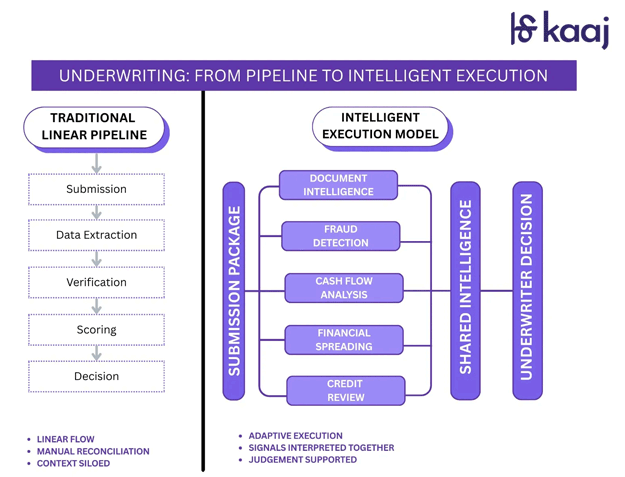
What an Intelligence Layer Looks Like in Practice
An intelligence layer in underwriting is not simply a context bridge between existing tools. It is an execution system designed to perform the heavy analytical work that traditionally consumes underwriters’ time, while structuring outputs in a way that supports informed judgment.
Rather than moving documents through a rigid extract–score–route pipeline, it begins by understanding the entire submission as a cohesive package.
Large, unstructured files are automatically segmented, renamed according to internal conventions, and validated for completeness. Missing documentation is identified before review begins. Critical information from credit applications, even when handwritten, is extracted and structured directly into the lending system.
Verification does not stop at static data pulls. Business registration details are retrieved, validated, and documented with supporting evidence. Web presence, industry classification, and operational footprint are analysed in parallel. Address verification is performed through image recognition and cross-referenced with application data. Fraud detection models evaluate document integrity before financial analysis proceeds.
When bank statements are reviewed, the system does not merely label transactions. It performs full cash flow intelligence, distinguishing operating revenue from credit inflows, identifying expense ratios, detecting merchant cash advance stacking, and mapping debt obligations through payment patterns.
Financial statements and tax forms are automatically spread and standardised, ratios calculated, and trend analysis presented in structured formats that allow reviewers to focus on interpretation rather than preparation.
Credit reports are pulled and analyzed in conjunction with operating performance. Signals are not processed independently; they are synthesised into a structured credit write-up that reflects the interaction between bureau data, financial trends, bank behaviour, and policy thresholds.
The result is not an automated approval engine. It is a system that removes the mechanical workload while preserving decision authority. The underwriter remains central, but now operates with a consolidated, context-aware analysis rather than fragmented outputs.
Kaaj is built around this model. It performs the preparatory, investigative, and analytical tasks that traditionally require hours of manual effort, structures the findings into a coherent narrative, and aligns them against policy before human review. In doing so, it enables underwriting teams to process complex submissions efficiently without diluting judgment or compliance.
Scalable underwriting does not come from adding more tools to the stack. It comes from redesigning execution around intelligence.