Residual value insurance is an indemnity against loss from a decline in value of an asset due to changes in market value when the asset is used and maintained as intended. The type of Residual Value Insurance (RVI) discussed in this article is “last loss” residual value insurance. Some call it “FASB” insurance when it is purchased by lessors to change the lease classification of an operating lease and, thus, accounting treatment of operating leases to the more favorable direct finance lease treatment for lessors under Topic 842, the governing US accounting rule for lessor accounting.
Direct finance lease (DFL) accounting is very similar to the accounting for a loan. Many lessors, especially bank-owned leasing companies, consider their leases to be economically similar to a loan - yet some leases fail the ASC 842 classification 90% test because of the residual assumption and must be accounted for as operating leases (same as a rental of the asset, where rent is the revenue and the asset is depreciated). DFL accounting is more representative of their “finance” businesses versus operating lease accounting, and DFL accounting results in improved financial reporting ratios and measures impacted by investing in leases. “FASB” RVI coverage provides some equipment risk protection, but its low premium reflects the low level of loss protection. Residual value insurance is also used for higher levels of risk protection in other asset finance transactions such as balloon financing, and lease securitizations. Residual insurance is also used for purely asset risk protection by users of hard assets.
Why is RVI a popular product for financial institution lessors?
RVI is a popular product among financial institution leasing businesses to convert the classification of operating leases to DFL accounting, as the parent company (a bank or independent finance company) has financial reporting ratios and measures that are negatively impacted by operating lease accounting. Operating lease treatment deteriorates a lessor’s efficiency ratio and has a less favorable pattern of earnings recognition that negatively impacts earnings per share (EPS) and return on assets (ROA) as compared to DFL presentation.
DFLs are more desirable than operating leases because their financial reporting better represents the financial institution lessor’s view of the economics of leases. Unfortunately, if a lease fails the present value (PV) of payments classification test in Topic 842 (the key classification test), an otherwise profitable lease can appear less profitable when it is classified as an operating lease. The issue is that the lease, by its terms, does not pass the 90% PV test. The good news is that RVI is considered a lease payment for classification purposes, and its purchase can increase the PV of payments to pass the test.
How does the purchase of RVI change the lease classification?
US lessor accounting rules classify leases as either direct finance or operating leases through a five-test analysis to determine if the lessor or lessee has the risks and rewards of ownership of the leased asset. The classification tests include both facts and judgments. If any of the tests are answered “yes,” the lease is classified as a DFL, a good outcome. Four tests cannot be changed by the lessor, and they are: do the lease terms include an automatic transfer of title or a bargain purchase option, is the lease term substantially all of the asset’s useful life (75% is the bright line to aid in judgment), and is the asset so specialized that it is of no other use to the lessor? The only test that can be changed is the “90% present value of payments test”, that is, whether the payments, as defined, return substantially all of the cost of the asset (90% is the bright line allowed to aid in judgment as to what constitutes “substantially all”). Included in the defined payments are third-party residual guarantees. Therefore, the lessor can buy residual insurance in an amount sufficient to pass the “PV” test, and the classification can be changed to a DFL.
RVI also works for IFRS 16 lessors as well, but that is not covered by this article.
Financial Reporting Benefits
An operating lease is financially reported as a non-financial asset that creates depreciation expense, which deteriorates a lessor’s efficiency ratio (operating expenses divided by net revenue). Specifically, the leased asset is considered a fixed asset (like an ATM, PC, or building – the operating assets a bank uses in its business), and the depreciation cost is considered an operating expense – both of which are foreign to bank-financing products. In an operating lease, the rent less funding costs is added to net revenue, and the depreciation expense is considered an operating expense and is added to operating expenses. The operating efficiency ratio worsens.
On the other hand, a direct financing lease is recorded as a financial asset with net finance revenue (lease revenue net of funding costs), but without non-financial expenses. This creates revenue for the lessor without additional operating expenses, which improves a lessor’s efficiency ratio. A lessor’s efficiency ratio is a key measure that investors and lenders use to evaluate the profitability of financial institutions. If a lessor’s efficiency ratio is lower (lower is better, that is, fewer expenses needed to create revenue), then the lessor is more attractive to shareholders. Studies have shown a direct correlation of operating efficiency to share price.
A DFL also has a better earnings pattern when compared to an operating lease – which is preferred by shareholders because there are constant earnings versus the declining lease asset balance rather than back-ended earnings. This further improves measures like earnings per share and return on assets, which are also important measures used by investors to evaluate profitability. The conversion to finance lease classification creates a positive timing difference, with the additional cost being the RVI premium. The timing difference is attractive to shareholders as they want earnings now, even at a slight cost. Shareholders trade in and out of investments and do not want to wait for returns.
In other words, classifying a lease as a finance lease rather than an operating lease creates real shareholder value through accelerated earnings and the perceived value that results from better ratios and measures. You are how you are perceived.
The financial benefits are the same for IFRS lessors.
Two case studies:
The following is a case study analyzing the financial benefits of using RVI to convert the classification of a synthetic operating lease of an auto.
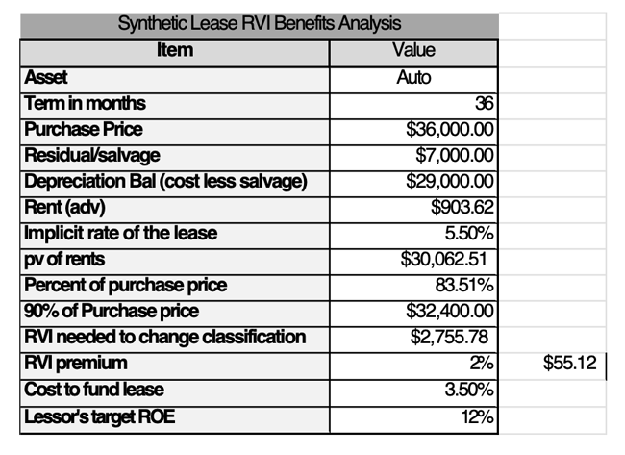
Per the assumptions, the lease would be classified as an operating lease for the lessor, as the present value of the rents using the implicit rate in the lease is 83.51% of the asset cost.
The amount of RVI needed to change the PV of the lease payments to equal 90% is $2,755.78, and the resulting insurance premium is $ 55.12, which is a P&L expense amortized straight line over the lease term. This is an added cost to the direct finance side of the case study.
The lessee must decide if buying RVI to convert the lease to a DFL is a sound financial reporting choice, or if operating lease accounting is acceptable. Pro forma calculations are run comparing the two lease classifications’ impact on the operating efficiency ratio and its return on assets.
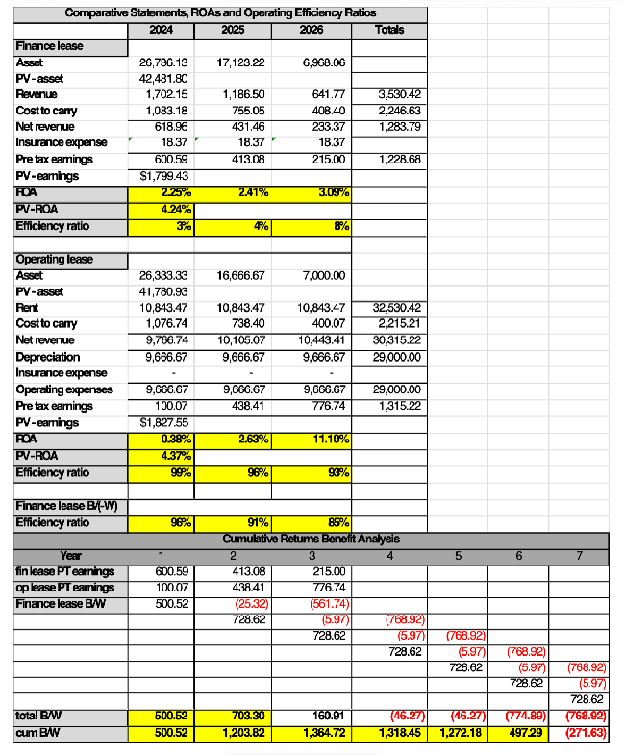
The results listed below show that the operating efficiency ratio impact is clearly more favorable (3% for the finance lease vs 92% for the operating lease, where the lower the better) and that alone could be all that is needed to endorse buying RVI. The other concern is how seriously the additional premium deteriorates the return on assets of the lease investment. The returns on the operating lease are back-ended while the returns on the finance lease are constant versus the declining lease asset balance. The timing difference turns around at the midpoint of the lease.
Since the two accounting methods have “apples to oranges” financial reporting results, the ROAs of the two cases are calculated on a present-value weighted average (PVROA) to create a valid basis for comparison. Read my article “Apples to Oranges” on how to compare alternative financial products: https://www.equipmentfa.com/blogs/41590/apples-to-oranges-how-to-compare-asset-finance-options
The DFL PVROA is worse by 13 bps (4.24% vs 4.37%) due to the cost of the RVI premium, but the first year's ROA is significantly better, and when viewed over time, the front-ending benefits of converting to DFL accounting last for 6 years. When considering that shareholders have a time-valued preference for earnings, it appears buying RVI is a good decision.
Adopting a policy of converting all operating leases to DFLs would make the timing differences permanent for the portfolioas new leases replace expiring leases.
The following is a case study analyzing the financial benefits of using RVI to convert the classification of an FMV operating lease of an auto.
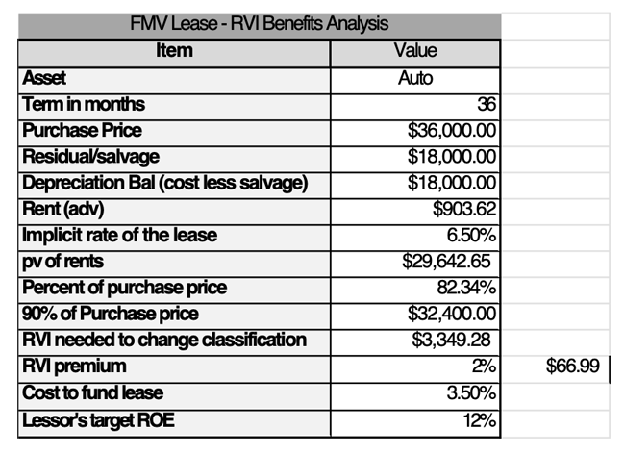
Per the assumptions, the lease would be classified as an operating lease for the lessor, as the present value of the rents using the implicit rate in the lease is 82.34% of the asset cost.
The amount of RVI needed to change the PV of the lease payments to equal 90% is $3,349.28, and the resulting insurance premium is $66.99, which is a P&L expense amortized straight line over the lease term. This is an added cost to the direct finance side of the case study.
The lessee must decide if buying RVI to convert the lease to a DFL is a sound financial reporting choice, or if operating lease accounting is acceptable. Pro forma calculations are run comparing the two lease classifications’ impact on the operating efficiency ratio and its return on assets.
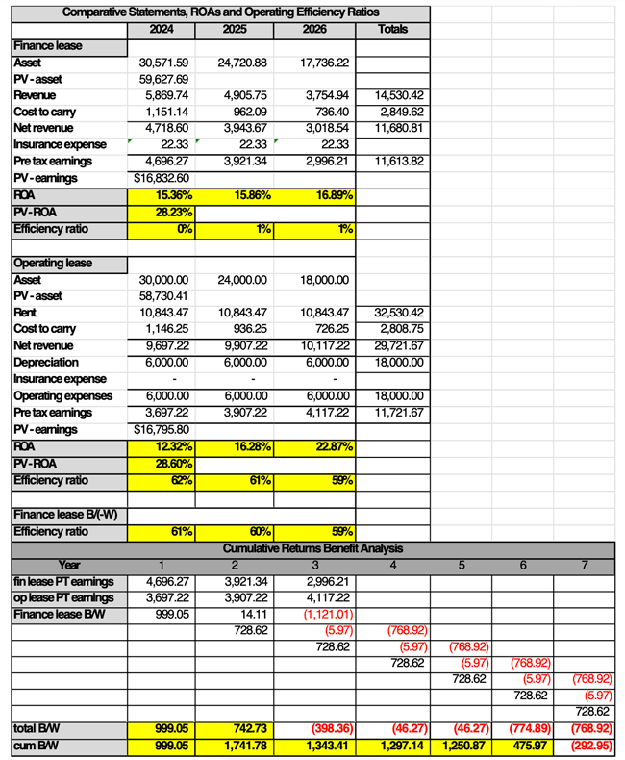
The results listed below show that the operating efficiency ratio impact is clearly more favorable (1% for the finance lease vs 61% for the operating lease, where the lower the better) and that alone could be all that is needed to endorse buying RVI. The other concern is how seriously the additional premium deteriorates the return on assets of the lease investment. The returns on the operating lease are back-ended while the returns on the finance lease are constant. The timing difference turns around at the midpoint of the lease.
Since the two accounting methods have “apples to oranges” financial reporting results, the ROAs of the two cases are calculated on a present-value weighted average (PVROA) to create a valid basis for comparison. The DFL PVROA is worse by 37bps (28.23% vs 28.60%), due to the cost of the RVI premium, but the DFL ROA is significantly better in the first year, and when viewed on a portfolio basis over time, the front-ending benefits of converting to DFL accounting last for 6 years. When considering that shareholders have a time-valued preference for earnings, it appears buying RVI is a good decision.
Adopting a policy of converting all operating leases to direct fiancé leases would make the timing differences permanent for the portfolio as new leases replace expiring leases.